
Dynamic Thermal Modelling and Operational Energy Simulation
Dynamic Thermal Modelling and Dynamic Energy Simulation allow us to model buildings and measure the impact of each construction parameter on the building's energy performance level.
Definition of Dynamic Thermal Modelling
Dynamic Thermal Modelling refers to a type of thermal simulation where the modeled system is not in equilibrium:
at any given moment during the simulation, the temperature of its components can vary according to the different laws governing heat exchange (convection, conduction, radiation, phase change).
Dynamic thermal simulation allows for the precise calculation of energy consumption, taking into account the building envelope and its thermal inertia, energy systems, occupant behavior, and the local climate. The study is conducted at hourly intervals over a year. It enables detailed modeling of the building's behavior in order to optimize its renovation with regard to heating needs and summer comfort.
at any given moment during the simulation, the temperature of its components can vary according to the different laws governing heat exchange (convection, conduction, radiation, phase change).
Dynamic thermal simulation allows for the precise calculation of energy consumption, taking into account the building envelope and its thermal inertia, energy systems, occupant behavior, and the local climate. The study is conducted at hourly intervals over a year. It enables detailed modeling of the building's behavior in order to optimize its renovation with regard to heating needs and summer comfort.
Definition of Operational Energy Simulation
In addition to the STD, calculation of all the building's energy consumption based on the description of its equipment.
The benefits of performing a STD and/or a SED
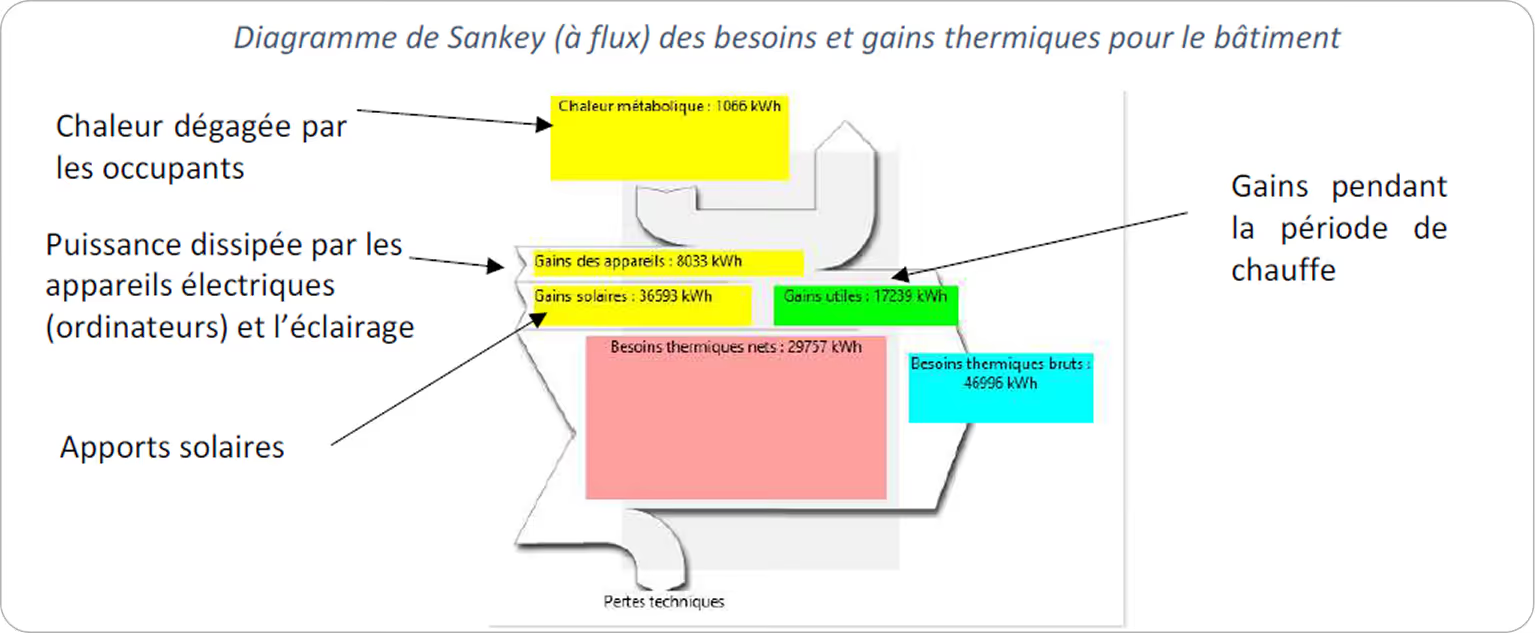
Dynamic Thermal Modelling and Operational Energy Simulation accurately calculate energy consumption and comfort by modeling, hour by hour over a year, the building envelope (inertia, thermal bridges, airtightness), energy systems, occupant behavior, and local climate. They enable the optimization of design or renovation with regard to heating needs and summer comfort. In low-energy buildings, phenomena that were once secondary become crucial: solar and internal heat gains, thermal bridges, and airtightness. Highly insulated, these buildings are more susceptible to summer overheating (the "thermos effect"); it is therefore necessary to limit heat gains, maximize thermal inertia, and implement a natural cooling strategy. DTS and DES are specifically used to quantify the impact of architectural and technical choices on energy and comfort upstream, in order to assess different scenarios and ensure the building's actual performance.
Dynamic Thermal Modelling and Operational Energy Simulation: for new construction and renovation
A standardized technical design (STD) or a specific energy performance assessment (SED) is necessary during the design phase of a construction project to validate low-energy consumption objectives. It is also essential for existing buildings when developing a renovation strategy. In this latter case, a series of STDs and/or SEDs are conducted to test different technical solutions at every level (building envelope, ventilation, heating, glazing, equipment, etc.). This allows for finding the optimal balance engineering consultancyween performance and return on investment, and establishing an energy renovation strategy that achieves good energy performance with minimal payback time.
Be careful not to confuse STD and regulatory thermal study!
The STD simulation should not be confused with a regulatory thermal study. The calculation engine is different.
A regulatory calculation is based on conventional scenarios defined for each type of building (log), whereas the goal of STD is to create a digital model of the building to which current occupancy conditions are applied.
FAQ
Dynamic Thermal Modelling and Operational Energy Simulation
What input data do you need to provide for a reliable STD?
Plans (levels/facades, glazed floor areas, solar shading), building envelope composition (U-value, thermal inertia, thermal bridges), occupancy scenarios, setpoints (heating/cooling/ventilation), equipment (efficiency, regulation), internal heat gain profiles (uses), and local climate (weather files). If some information is missing, we make traceable assumptions and indicate the impact on uncertainty. Since the STD is hourly, the quality of the inputs directly determines the quality of the outputs.
What comfort and performance indicators do you provide?
Depending on the building type, we can provide: discomfort hours (operating temperature), EN 16798-1 adaptive criteria (comfort categories), and, upon request, CIBSE TM52/TM59 analyses for overheating risk (excess hours, daily weighted exceedance, nighttime limits in bedrooms). Also provided are: load curves, power demand, contributions from heat gains, and a comparison of scenarios.
Can you test future heatwaves and climate resilience 2030–2050?
Yes. We can simulate hot weather files and heatwave scenarios to assess resilience (thermal inertia, solar shading, night ventilation, free cooling) and compare passive/active strategies before any work begins. These approaches are common for evaluating how well buildings adapt to future heatwaves.
How do you guarantee the reliability of the results (and the link with RE2020)?
The calculation engine used for the STD follows practices validated by reference protocols (e.g., model comparisons with ASHRAE 140 in the literature). The STD does not replace the RE2020 (regulatory calculation “Th-BCE”) but complements it for summer comfort and the fine-tuning of technical choices. During the operational phase, we can cross-reference the data with measurements (BMS, data loggers) to refine the settings.
Contact
the Engineering Consultancy
Do you have a question? Would you like to contact someone in the engineering consultancy?